
Your body is not passive. Right now, without any conscious input, it’s regulating temperature to within a fraction of a degree, adjusting inflammatory response, modulating pain, and calibrating the sleep pressure that will eventually pull you toward rest. It is doing this continuously, simultaneously - and largely invisibly.
Most people know about the nervous, immune, and endocrine systems. Almost nobody is taught about the one that talks to all of them.
The endocannabinoid system (ECS) is the body's master regulatory network. It sits at the intersection of virtually every other system in the body, coordinating the constant self-correction that keeps us functional (3). And yet it was mapped only in the 1990s, decades after every other major system had been identified. It still barely features in mainstream health education.
In this article, we'll look at what homeostasis means at a biological level, which processes the ECS is actively governing, what disrupts it, and what supports it. Whether you've heard of the ECS before or this is entirely new territory, the science here changes everything, and it’s worth knowing.
Homeostasis meaning: what your body is actually doing 24/7

The homeostasis definition is often simply put as the body "maintaining balance", which is accurate but undersells how extraordinary the process is.
A more useful definition of homeostasis is this: the continuous, dynamic process by which the body detects deviations from an optimal state and acts to correct them.
Every cell, tissue, and organ system is involved. The targets aren't abstract: core temperature must stay within a narrow band. Blood glucose must neither spike dangerously nor fall too low. Mood must stay relatively steady rather than swinging when small stressors hit. Inflammation must be triggered when needed and resolved when the threat passes. Sleep pressure must build across the day and then clear during the night. Pain signals must be amplified when the body needs attention and dampened once the message is received.
These aren't separate processes happening in parallel. They're interlocking and constantly influencing one another. Chronic stress disrupts sleep. Poor sleep elevates inflammatory markers. Elevated inflammation lowers pain thresholds. A disrupted pain threshold affects mood. Mood affects stress. The body is a feedback system - not a collection of independent parts.
This is why the endocannabinoid system has such a profound impact on this delicate dance of processes. The ECS doesn't own one domain - it operates across all of them. It's the signalling layer that helps these systems communicate and self-correct. When researchers began mapping it in the early 1990s, discovering the receptors, the endocannabinoids the body produces naturally, and the enzymes that regulate them, they found them distributed throughout the brain, immune system, gut, reproductive organs, and skin. Everywhere, essentially. The question wasn't where the ECS operated - It was where it didn't!
That it took until the 1990s to identify it is partly a story of scientific sequencing - cannabinoid receptors were only found because researchers were investigating THC, the compound in cannabis - and partly a reflection of how difficult it is to study a system that's woven through everything else. The delay means we're still catching up.
But what we know is already significant.
The 3 dials the ECS (Endocannabinoid System) controls

Think of the ECS as a dimmer system rather than a set of on/off switches. It's not triggering responses so much as modulating them - turning signals up or down in response to what the body needs in the moment (3). Three of its most important regulatory roles are the stress response, pain threshold, and sleep pressure.
Stress response
When a threat is detected - real or perceived - the sympathetic nervous system activates, and cortisol rises. This is appropriate and necessary. The ECS's role is to act as the countersignal: once the threat passes, endocannabinoids help bring the stress response back down, facilitating the shift from fight-or-flight back to rest and repair (4).
When the ECS is under strain from chronic stress, this countersignal weakens. The system stays activated longer than it should. Cortisol remains elevated. The body has less capacity to return to baseline, which is why prolonged stress doesn't just feel exhausting - it is physiologically costly in ways that compound over time.
Pain threshold
The ECS is deeply involved in how pain signals are processed and modulated. Endocannabinoids act on receptors throughout the pain pathway, influencing how intensely signals are experienced and how long they persist. This is why pain sensitivity isn't fixed - it varies day to day depending on sleep, stress, inflammation, and the overall state of the ECS. When the system is well supported, minor discomfort remains minor. When it's under strain, the same stimulus lands harder. If you've ever noticed that everything seems to ache more during periods of stress or after poor sleep, that's not a coincidence. That's the ECS losing ground.
Sleep pressure
Sleep is a homeostatic process - the pressure to sleep builds across the day through the accumulation of adenosine, and the ECS plays a direct role in this signalling, influencing both the drive toward sleep and the quality of the sleep achieved. When ECS tone is compromised, sleep architecture suffers: it becomes harder to fall asleep, sleep is lighter once you're there, and sleep is less restorative overall. The consequence feeds directly back into stress and pain sensitivity, completing a loop that can be genuinely difficult to interrupt without understanding what's driving it.
What disrupts ECS balance – and what that actually feels like?

How the ECS (endocannabinoid system) supports physiological balance (homeostasis) and general wellbeing: from disruption to regulation
ECS disruption rarely announces itself clearly. It tends to show up as a collection of overlapping, low-grade experiences that are easy to attribute to other things: stress, age, a busy period, not looking after yourself. Which isn't wrong, but it's not the whole story.
The concept of endocannabinoid tone refers to the baseline activity and responsiveness of the ECS. A high tone means the system is working well: stress responses resolve, pain signals are proportionate, sleep is restorative. A lower tone indicates the system is less capable of performing its job across all those domains simultaneously.
The endocannabinoid tone is related but different from the concept of clinical endocannabinoid deficiency which we cover in more depth in a separate article.
Several common lifestyle factors consistently reduce endocannabinoid tone (4). Chronic stress is perhaps the most significant: sustained cortisol elevation disrupts ECS signalling and depletes the endocannabinoids the body produces naturally. Poor sleep is both a cause and a consequence - the ECS supports sleep, but disrupted sleep further impairs the ECS. A diet high in processed foods and low in essential fatty acids undermines the structural building blocks the body needs to produce endocannabinoids in the first place. Alcohol, particularly when consumed regularly and in volume, alters receptor sensitivity over time. A sedentary lifestyle removes one of the most reliable natural stimulants of endocannabinoid production.
The lived experience of all of this tends to feel like: wired but tired, unable to switch off but not actually rested; an increase in pain sensitivity, where things that wouldn't previously have bothered you now register more sharply; sleep that is technically happening but not refreshing; digestion that feels sluggish or inconsistent; a general sense that your buffer against stress has thinned.
None of this is unusual. It's also not something to simply push through. It's information about what the system needs.
What supports ECS balance – lifestyle first
The ECS is responsive. It doesn't just deplete passively - it rebuilds when given the right inputs. They're the fundamentals that the body was designed around.
Exercise
Exercise is one of the most reliable ways to stimulate endocannabinoid production. The much-discussed 'runner's high' was long attributed to endorphins, but more recent research points significantly to anandamide - one of the body's primary endocannabinoids, sometimes called the 'bliss molecule' - as the driver of that post-movement sense of ease and clarity (1). You don't need to run to get the effect. Rhythmic, sustained movement of most kinds - cycling, swimming, walking at pace, dancing - appears to stimulate endocannabinoid release. This is one of the most compelling reasons to think of movement not as a discipline, but as direct support for how you feel.
Omega-3 fatty acids
Omega-3 fatty acids matter here in a way that goes beyond their reputation for general health. Endocannabinoids are derived from fatty acids, and the omega-3 to omega-6 ratio in the diet directly influences the structural quality of cell membranes and, in turn, endocannabinoid signalling (4). Diets high in processed seed oils and low in oily fish, flaxseed, or walnuts tend to skew this ratio in ways that compromise ECS function over time. This is one of the more direct nutritional levers available.
Sleep consistency
Sleep consistency (not just duration, but regularity) supports ECS tone in ways that variable sleep schedules don't, even if the total hours are similar. The body's endocannabinoid system is sensitive to circadian rhythm; keeping sleep and wake times consistent, even at weekends, is one of the quieter but more impactful choices available.

Stress regulation
Stress regulation (through breathwork, movement, time in nature, or whatever form of genuine recovery works for the individual) directly supports endocannabinoid tone by reducing cortisol, which depletes it (4). The physiological sigh (a double inhale through the nose followed by a long exhale) remains one of the fastest evidence-backed tools for shifting the nervous system toward parasympathetic tone and, with it, creating conditions where the ECS can do its work.
Where CBD and supplements fit in
Once lifestyle foundations are in place, targeted supplementation can support ECS tone further - and this is where CBD becomes relevant.
CBD's relationship with your cannabinoid receptors is often misunderstood. CBD doesn't produce effects by directly mimicking the body's endocannabinoids. Its primary mechanism is more indirect: it inhibits the enzyme FAAH, which breaks down anandamide. The result is that the body's own anandamide - already present, already doing its regulatory work - persists for longer (4). This is a support function, not a replacement.
Full-spectrum CBD products take this further through what's known as the entourage effect: the principle that cannabidiol works more effectively alongside the other naturally occurring compounds in the hemp plant (minor cannabinoids, terpenes, and flavonoids) than it does in isolation. Rather than a single compound doing all the work, the full plant profile creates a more nuanced interaction with the ECS, one that more closely reflects how the system evolved to be supported.
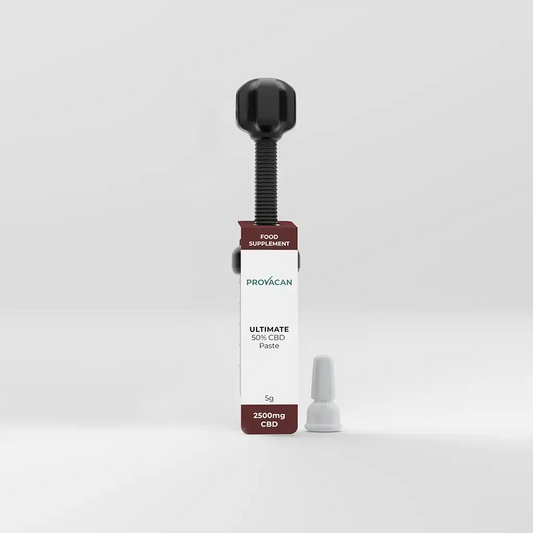
If you're looking for a place to start, Provacan's CBD full-spectrum range is formulated with this in mind to support your ECS, and is developed with clinical input and third-party tested for quality and consistency.

Final thoughts: balance isn't something you achieve, it's something you support
We all possess a built-in system for balance. It's been working since birth, and it responds - continuously, dynamically - to how you live. The endocannabinoid system isn't alternative medicine or a wellness trend - It's a fundamental part of physiology. Helping to regulate stress response, pain threshold, sleep, and inflammatory balance every single day.
What's worth understanding is that it's not self-sustaining in isolation. It's shaped input: movement, sleep, food, stress load, and the cumulative quality of daily life. Supporting it isn't complicated, but it is consistent. Small, regular inputs compound into meaningful change in the same way that chronic depletion does - just in a more useful direction.
If you're not sure where to start, our wellbeing quiz can help identify where support might be most useful. And if you'd like to explore things further with clinical guidance, consultation bookings are always open.
Sources
- Fuss, J., Steinle, J., Bindila, L. et al. (2015). A runner's high depends on cannabinoid receptors in mice. Proceedings of the National Academy of Sciences, 112(42), pp.13105–13108. https://www.pnas.org/doi/10.1073/pnas.1514996112
- Russo, E.B. (2016). Clinical endocannabinoid deficiency reconsidered: current research supports the theory in migraine, fibromyalgia, irritable bowel, and other treatment-resistant syndromes. Cannabis and Cannabinoid Research, 1(1), pp.154–165
- Zou, S. and Kumar, U. (2018). Cannabinoid receptors and the endocannabinoid system: signalling and function in the central nervous system. International Journal of Molecular Sciences, 19(3), p.833. https://www.mdpi.com/1422-0067/19/3/833
- McPartland, J.M., Guy, G.W. and Di Marzo, V. (2014). Care and feeding of the endocannabinoid system: a systematic review of potential clinical interventions that upregulate the endocannabinoid system. PLOS ONE, 9(3), e89566